With two and a half pence his mother had given him, Isaac was able to buy a tiny notebook, sewn sheets bound in vellum. He asserted his ownership with an inscription: Isacus Newton hunc librum possidet. (Latin for "Isaac Newton possesses this book")
Over many months he filled the pages with meticulous script, the letters and numerals often less than one-sixteenth of an inch high. He began at both ends and worked toward the middle. Mainly he copied a book of secrets and magic printed in London several years earlier: John Bate’s Mysteryes of Nature and Art, a scrap book, rambling and encyclopedic in its intent.
He copied instructions on drawing. “Let the thing which you intend to draw stand before you, so the light be not hindered from falling upon it.”
“If you express the sunn make it riseing or setting behind some hill; but never express the moon or starrs but up on necessity.”
He copied recipes for making colors and inks and salves and powders and waters.
“A sea colour. Take privet berries when the sun entreth into Libra, about the 13th of September, dry them in the sunn; then bruise them and steep them.”
Colors fascinated him. He catalogued several dozen, finely and pragmatically distinguished: purple, crimson, green, another green, a light green, russet, a brown blue, “colours for naked pictures”, “colours for dead corpses”, charcoal black and seacoal black.
He copied techniques for melting metal (in a shell), catching birds (“set black wine for them to drink where they come”), engraving on a flint, making pearls of chalk.
Living with Clarke, apothecary and chemist, he learned to grind with mortar and pestle; he practiced roasting and boiling and mixing; he formed chemicals into pellets, to be dried in the sun. He wrote down curses, remedies, and admonitions:
Things hurtfull for the eyes
Garlick Onions and Leeks…Gooing too suddaine after meals. Hot wines. Cold ayre…Much blood-letting…dust..ffire..much weeping..
A short yet illuminating biography of Isaac Newton by a brilliant science writer, James Gleick
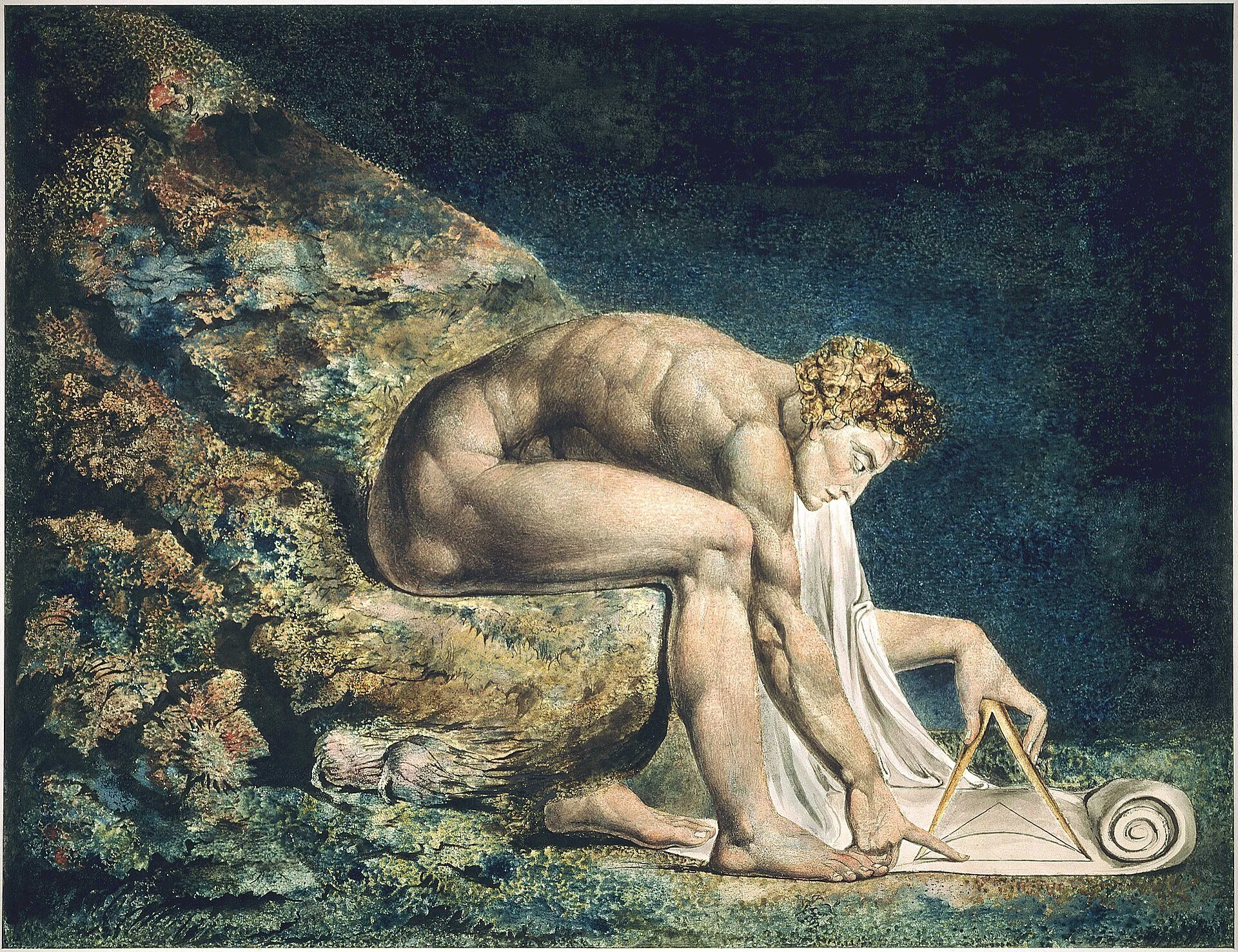
Newton is a monotype by the English poet, painter and printmaker William Blake first completed in 1795. Isaac Newton is shown sitting naked and crouched on a rocky outcropping covered with algae, apparently at the bottom of the sea. His attention is focused upon diagrams he draws with a compass upon a scroll